4. Stopping Power Calculations
Three classes handle the interaction of particles with bulk matter.
Element and Compound describe the materials: their charged-particle
stopping powers and ranges (Andersen–Ziegler formulation, any element up
to uranium), and their photon attenuation coefficients. Stack puts
materials in a beam: it transports charged particles through a stack of
foils and computes the energy distribution of the beam in every layer —
the quantity that connects an irradiation to its cross sections.
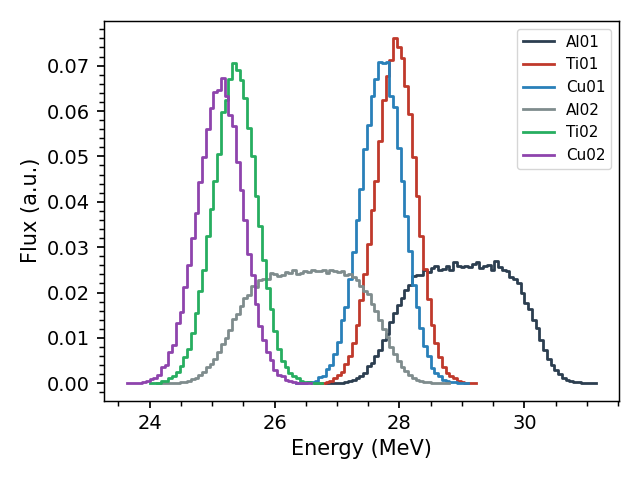
A 30 MeV proton beam degrading through a six-foil stack: each foil sees a lower, wider energy distribution.
Workflow. Element and Compound answer design questions directly — how much
energy does a proton lose in this foil (S), how thick a degrader do I
need (range), how strongly does this sample absorb gamma rays
(attenuation). A Stack calculation follows three steps:
Define the materials: natural elements by symbol, compounds by chemical formula, preset name (
ci.COMPOUND_LIST), or explicit elemental weights.Define the stack: an ordered list of foils (first foil hit first), each with a compound and enough information to fix its areal density (mass per unit beam area, in mg/cm2), and a
namefor each foil you want tallied.Transport and use:
ci.Stack(stack, E0=..., particle='p')computes every foil’s mean energy, energy width and full flux distribution (the “flux” here is the beam’s energy spectrum within the foil, not a particles-per-area rate) — andrx.average(*st.get_flux('name'))turns the latter into the effective cross section of that foil.
See the Stopping Power How-to Guide for each step in detail, the Stopping Power Worked Examples for the build-up from single stopping powers to the thin-vs-thick foil comparison, and Stopping Power Troubleshooting for the common pitfalls.
Uses and limitations. The stopping powers are the Andersen–Ziegler semi-empirical parameterization (see Stopping Power and Particle Transport): protons, deuterons, tritons and alphas are supported directly, and heavier ions through an effective-charge scaling. Compound stopping powers use Bragg additivity (weighted sums of the elemental values), which neglects chemical-bonding effects — a percent-level approximation, worst for light compounds at low energies.
Stack models energy loss only: particles slow down but are never
absorbed or deflected, so the computed flux distributions describe the
beam’s energy, not its attenuated intensity, and lateral spread is not
modeled. The width of each foil’s energy distribution has two parts:
the energy the beam loses between the foil’s front and back faces (which
alone makes a thick degrader’s distribution wide, even for a
monoenergetic incident beam), plus the incident beam spread (dE0)
and the extra spread the beam picks up as it degrades — slower particles
lose energy faster, so an initially narrow beam broadens as it slows.
The width is thus the range of energies the foil samples, not an
uncertainty on its mean energy. Collisional straggling — the
statistical spread in energy loss from the randomness of individual
collisions — is not added on top, so very thick degraders will in
reality produce a somewhat wider distribution than computed (see
Stopping Power and Particle Transport).