1. Spectroscopy
Curie provides two classes for analyzing gamma-ray spectra from high-purity
germanium (HPGe) detectors: the Spectrum class, which reads spectra and
performs peak fitting, and the Calibration class, which generates and
stores the energy, resolution and efficiency calibrations needed to convert
fitted peaks into activities.
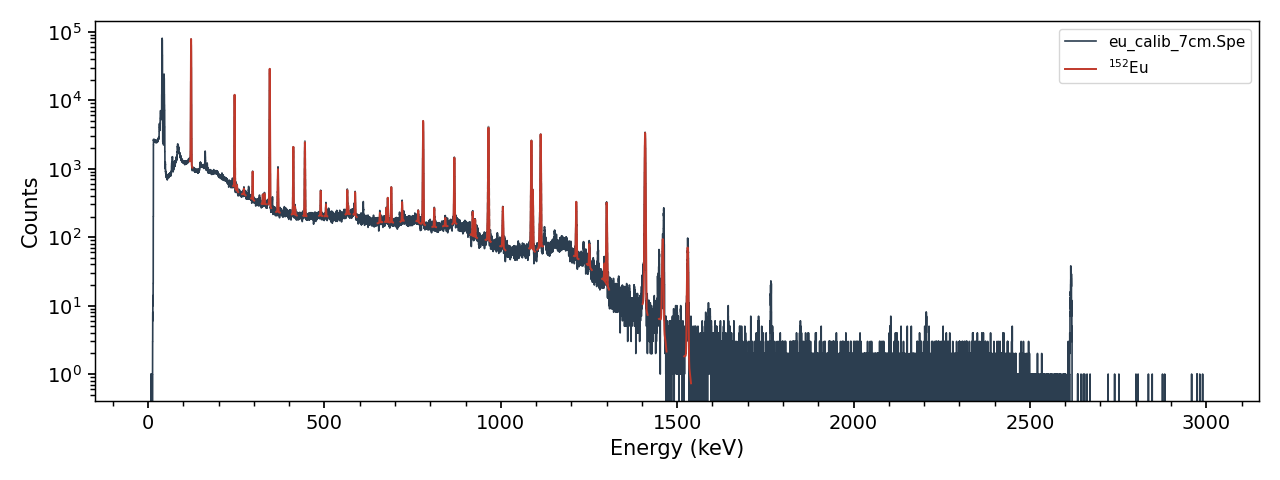
A 152Eu calibration spectrum with fitted peaks.
Workflow. A typical spectroscopy analysis proceeds in five steps:
Load a spectrum from disk:
sp = ci.Spectrum('eu_calib_7cm.Spe'). Ortec .Spe and .Chn and Canberra .CNF and .IEC formats are supported.Identify the gamma-decaying isotopes present:
sp.isotopes = ['152EU', '40K']. Curie retrieves their gamma lines from its decay data.Calibrate: apply a saved calibration for this detector and counting geometry:
sp.cb = 'eu_calib.json'.Fit the peaks:
sp.fit_peaks(), tuned by thefit_configoptions. The result is thesp.peakstable of counts, decays and activities per gamma line.Inspect and export:
sp.summarize(),sp.plot(), andsp.saveas()to .csv, .json, .db or .Chn.
These steps describe routine analysis with an existing calibration.
Creating that calibration is a separate, usually one-time task:
Calibration.calibrate() fits the peaks of reference-source spectra
itself, so it runs before any manual peak fitting (see the
Spectroscopy Worked Examples).
See the Spectroscopy How-to Guide for each step in detail, the Spectroscopy Worked Examples for a complete efficiency calibration with a 152Eu source, and Spectroscopy Troubleshooting for the most common pitfalls — most of them involving the energy calibration.
Uses and limitations. These classes are designed for activation analysis: quantifying the activities of known gamma-emitting isotopes in a counted sample. The peak-fit and efficiency models (described in Gamma-ray Peak Fitting and Detector Calibration) are tuned for HPGe data, and are not intended for low-resolution detectors such as NaI. Peak identification is driven by the assigned isotope list — Curie fits the gamma lines it expects from those isotopes, rather than hunting for unidentified peaks. True-coincidence summing — two gammas from the same decay cascade arriving together and counted as one event — is not corrected; it matters mainly for samples counted very close to the detector, so calibrate at a moderate source-to-detector distance or with single-line sources.