2. Isotopes & Decay Chains
Curie provides two classes for working with radioactive decay. The
Isotope class looks up nuclear data for a single isotope: masses,
abundances, half-lives, the energies and intensities of its emissions
(gammas, betas, alphas, conversion electrons), and dose rates. The
DecayChain class
does the bookkeeping of decay itself: starting from a parent isotope it
builds the full chain of decay products, computes every member’s activity
as a function of time — during production as well as decay — and can fit
production rates or initial activities to measured data.
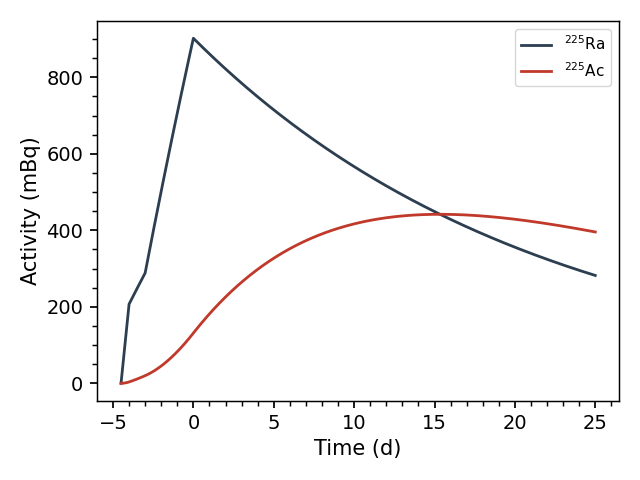
225Ra during and after production: the daughter 225Ac grows in as the parent decays.
Workflow. Isotope needs no workflow — construct it and read off the data (see
Isotope & Decay Chain How-to Guide). Decay-chain problems come in two directions:
Forward — you know (or assume) how much of an isotope was made, and want activities at later times: build the chain with an initial activity
A0or a production-rate historyR, then calldc.activity(),dc.decays()ordc.plot().Inverse — you measured decays (typically peaks in gamma-ray spectra) and want the production rate or activity that explains them: load the measurements with
dc.get_counts()and fit withdc.fit_R()(for production) ordc.fit_A0()(for decay-only).
Both directions share one time convention: t = 0 is the end of
production (the end of bombardment in an activation experiment), and
all times are in the chain’s units.
See the Isotope & Decay Chain How-to Guide for each task in detail, the Decay Chain Worked Examples for both directions worked on real examples, and Isotope & Decay Chain Troubleshooting for the common pitfalls.
Uses and limitations. Isotope serves quick lookups (a half-life in sensible units, a table of
gamma lines above some intensity) and provides the decay data that
Spectrum, Calibration and DecayChain use internally. The decay data
are compiled from ENSDF (via the IAEA LiveChart interface), with
NUBASE2020/AME2020 closures and ENDF/B-VIII.1 fission yields.
DecayChain solves the Bateman equations exactly (see
Radioactive Decay Chains), including chains with branching and
same-half-life members, for one parent isotope at a time with a
piecewise-constant production history. Production physics is not
computed — the production rate is an input, which you can fit from
measured counts, or estimate yourself from cross sections and particle
fluxes (the Reactions pages cover the cross-section side).